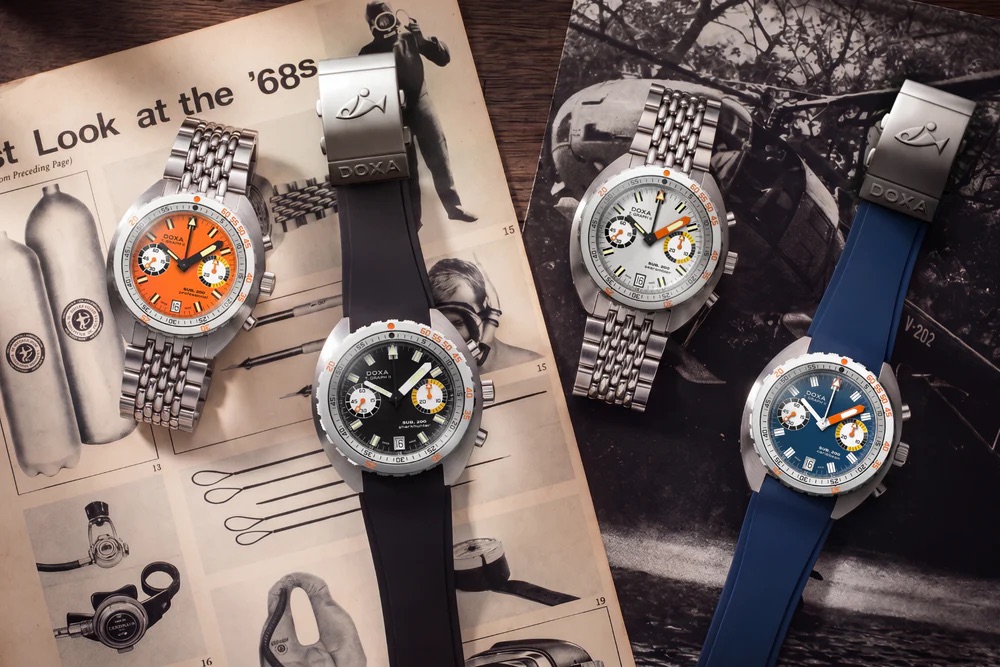
Doxa delighted the watch world this June when it released a revamped version of its rare dive chronograph, the T.Graph. Dubbed the Sub 200 T.Graph II and available as part of its permanent collection, the watch is a downsized, automatic take on what was originally a limited-production, hand-wound, dual-register chronograph that clocked in at roughly 45mm. With its more compact proportions, colorful dial combinations and overbuilt tech specs, the Sub 200 T.Graph II is finding fans among Doxa diehards as well as new converts. I recently spent a week with the watch to see if I would just as easily become an evangelist myself.
The Basics
The new Doxa Sub 200 T.Graph II departs from the original 1969 model in several important ways. Measuring 42mm rather than 45mm, it’s significantly more compact. Rather than use the Eberhard cal. 310-82 hand-wound movement, it instead uses a modern Sellita automatic movement, making it slightly more convenient for daily wear. Furthermore, the modern beads-of-rice bracelet lacks the original’s spring-loaded expansion feature, and instead relies upon a push-button dive extension. Depending upon one’s preferences, each of these could either be a feature or a bug. (I would argue that the downsizing to 42mm is a distinct feature, while the choice of automatic vs. hand-wound depends largely upon personal taste. The bracelet…well, I’ll get to that later.)
At $4,250 on a rubber strap and $4,290 on the aforementioned bracelet, and with 200 meters of water resistance, the T.Graph II sits at the mid or premium range for comparable dive chronographs with similar movements, and the more affordable price tier when compared to dive chronographs with in-house movements.
In the former camp, the Aquastar Deepstar Chronograph offers 200m of water resistance and an automatic La Joux-Perret cal. LJP82010 column-wheel movement for $2,900; the Ollech & Wajs Astrochron boasts 500m of water resistance and the automatic Valjoux cal. 7753 for roughly $3,500; and the Marathon 46mm CSAR offers 300m of water resistance and the automatic Valjoux cal. 7750 for $5,400. With respect to pieces with in-house movements, there’s the Tudor Black Bay Chrono 39 with 200m of water resistance at $6,725; the Breitling Superocean Heritage B01 Chronograph 42 with 200m of water resistance at $9,600; and the Glashütte Original SeaQ Chronograph with 300m of water resistance for $15,800.
The Case and Bezel
The famous tonneau case profile of virtually every beloved Doxa is present and accounted for on this T.Graph II. Measuring 42mm wide and a substantial 14.6mm thick, one would be forgiven for thinking that it must be an uncomfortably large piece. However, a lug-to-lug measurement of 44.5mm helps to significantly diffuse some of the on-wrist heft, meaning that on my 7-inch wrist, the watch wears quite comfortably. (This does not mean that you won’t accidentally slam the watch into the body of your friend’s Ford Bronco when opening the passenger door, of course, as I stupidly did. A case height of 14.6mm is tall even for a tool watch, no matter how you slice it.) But overall, don’t let the model’s dimensions scare you, as they’re much more manageable than you might think.
While the stainless steel case top is brushed, its sides are polished, lending it a slightly more luxurious look. The right-hand flank, meanwhile, is taken up by dual pump pushers and a screw-down crown. In its fully pushed-in position, the watch runs normally; in its second position, one can quickly update the quick-set date; and in the third position, the watch’s sweep-seconds hand at 9 o’clock stops moving, and the time can be precisely set. A screw-down caseback helps, in conjunction with the screw-down crown, to ensure that 200m of water resistance, though the pushers/chronograph shouldn’t be operated underwater.
Set atop the watch head is Doxa’s famous “no-decompression” bezel insert, which moves unidirectionally to track elapsed time while simultaneously keeping track of no-deco limits in meters. (When scuba diving, certain dive times/depths require a decompression stop during ascent in order to off-gas potentially dangerous nitrogen from the blood. The “no-deco” scale — which lets the diver know how long he or she can dive at certain depths without the need for a decompression stop during the ascent — was first incorporated by Doxa into an elapsed-time bezel in the form of the Sub 300 in 1967 and has since become a signature feature for the brand.) While modern dive computers now keep track of no-deco limits, the bezel itself is scalloped for easy grip, features 120-click resolution and can easily be manipulated underwater for tracking elapsed time. In short: as far as dive watch bezels go, it’s among the best.
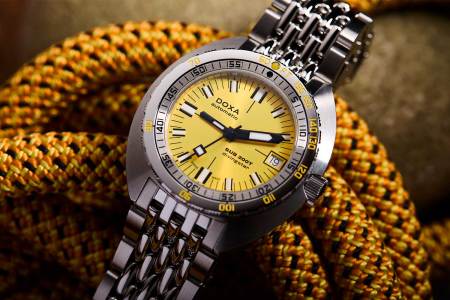
Doxa Finally Delivers the Goldilocks Dive Watch
The Sub 200T is a slim, 39mm version of the diver we all know and loveThe Dial
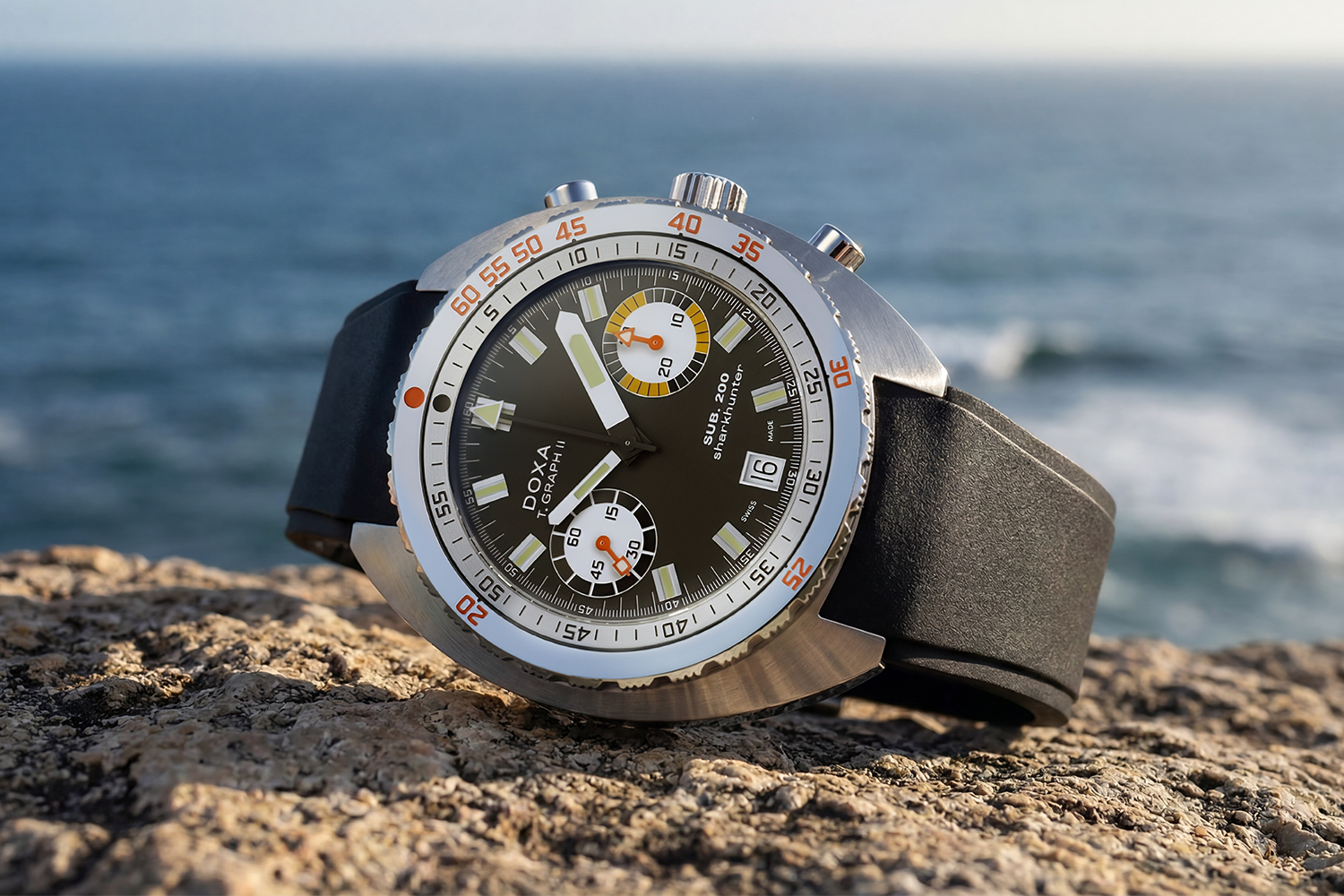
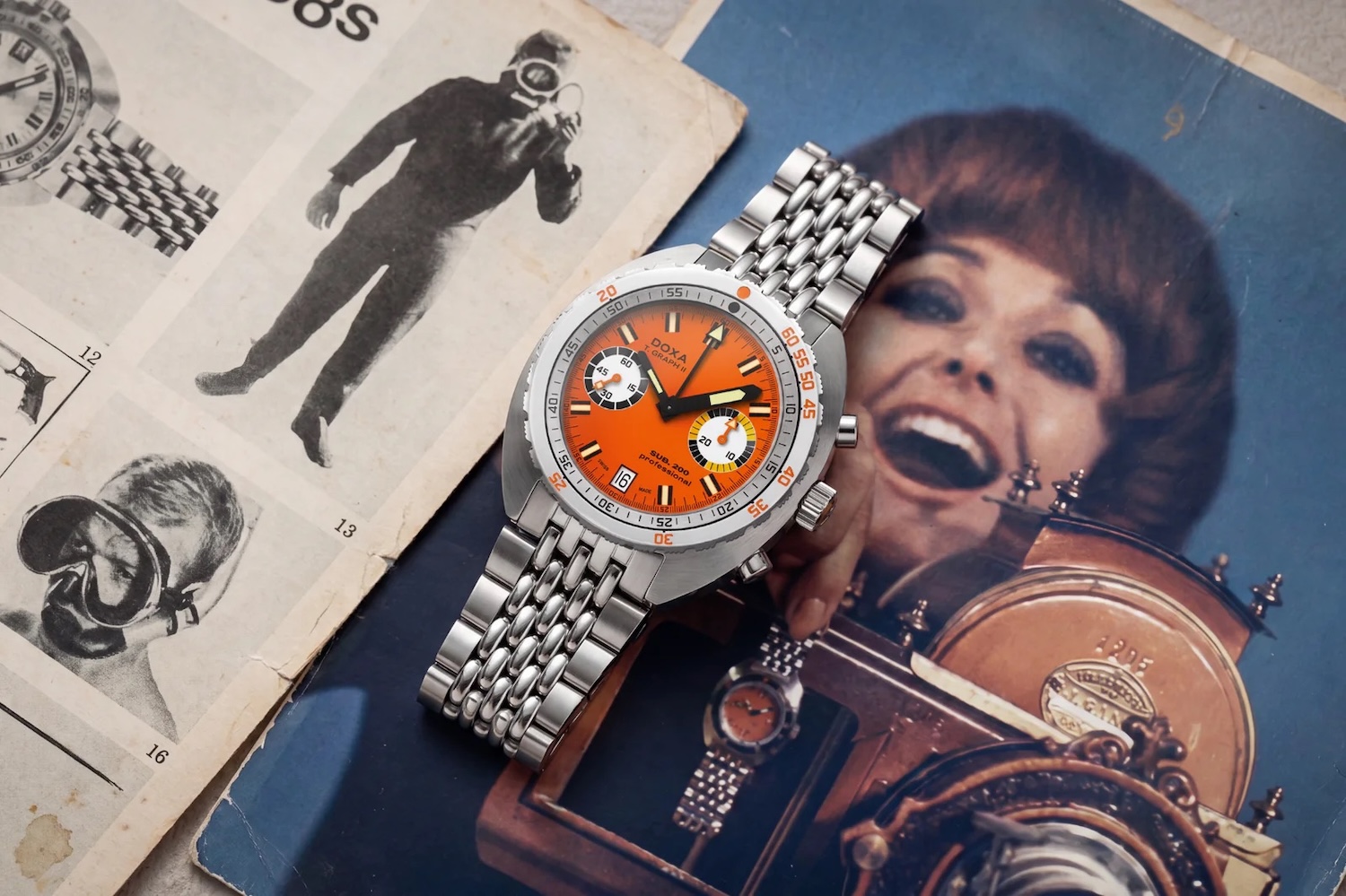
The T.Graph II dial comes in four classic Doxa colors: Professional orange, Sharkhunter black, Searambler silver and Caribbean blue. Each colorway has its fans and adherents amongst Doxa aficionados, but for my review, I chose to borrow the black Sharkhunter. Executed in a matte finish, it features an outer 1/5th-seconds track in white; luminous block indices in yellow and white; a framed date window at 6 o’clock with a white background and black printing; a 30-minute register opposed with a running-seconds register at 3 and 9 o’clock, respectively; and a sword handset with an oversized, luminous minute hand, a much smaller hour hand and an arrow-tipped central chronograph seconds hand. In addition to the make and model name, the dial also features the word “sharkhunter” — a quirk of the Doxa catalog, in which these named colors carry their own fame.
Accented with yellow and black and fitted with blocky orange hands, the chronograph registers add subtle pops of color to the dial design that look great in any colorway. (The subdials are the same in each reference.) Highly legible, idiosyncratic and distinctly ‘70s, the T.Graph II’s face is easy on the eyes and makes tracking elapsed time an actual pleasure. The offset text between 10 and 11 o’clock and 4 and 5 o’clock is quirky and fun — I suppose it could’ve been centered for a more elegant look, but the arrangement is satisfying in its adherence to the design of the original T.Graph.
Simply put, this is one of the coolest tool watch dials on the market, and I’m glad that Doxa did little to change it.
The Bracelet
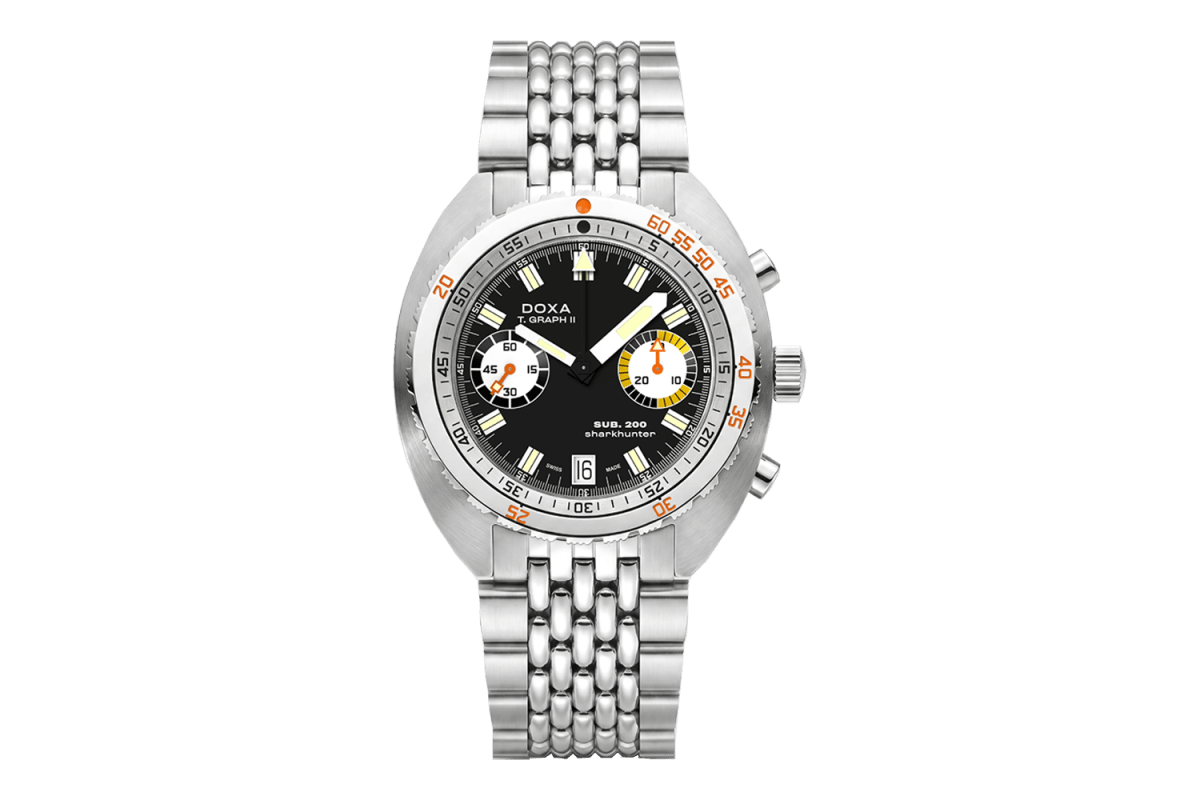
The bracelet is where I have beef with the T.Graph II. It’s a beads-of-rice design that mirrors the original model and has become a Doxa hallmark — but the overall watch, to my mind, would be better served by certain refinements to make it slightly more elegant.
First up is the attachment point at the end links: on the original T.Graph — as on many watches — the end links formed the widest point of the bracelet, after which a gradual taper slimmed down its physical and visual mass. On modern Doxa divers, this is no longer the case, as the end link is shorter in diameter than the follow-on link, from which the actual taper begins. Visually, I find this awkward and not terribly handsome, and wish the bracelet simply began with a 20mm end link and tapered directly from here. I don’t see any reason for the additional heft from fanning out into a 23mm link when, presumably, a 20mm bracelet would’ve been sufficient.
Don’t get me wrong, a beads-of-rice design is comfortable and elegant in and of itself, and already diffuses some of the watch head’s weight in a way that an Oyster-style bracelet certainly would not. But the progression from 20mm to 23mm is odd, and the progression down from 23mm to roughly 19.5mm at the clasp isn’t significant enough to provide a visual change that registers as anything other than hefty. A more significant taper would’ve been welcome.
Then we get to the clasp. Positively gargantuan at 22mm, it once again messes with the bracelet’s profile, and while its push-button design is fine, it doesn’t do the watch any favors The dive extension, which is activated by a second set of buttons, feels flimsy: given the design of the locking mechanism, it can too easily be clicked into its follow-on position, and having an extra bit of flat, stamped steel sticking out of the bracelet simply looks goofy.
While I frankly believe the T.Graph II itself is too cool a watch not to buy because of the bracelet’s lack of refinement, I certainly wish Doxa would address these shortcomings, perhaps in a “Mark II” version later in the watch’s development process. There’s no reason at this price point not to have a bracelet that is commensurate with the watch head in thoughtfulness.
The Movement
While the original T.Graph was powered by a hand-wound caliber from Eberhard — one of Doxa’s sister brands within the Synchron Group — the T.Graph II utilizes as its power plant the Sellita SW510, an automatic, cam-operated, Swiss-made engine with a beat rate of 4 Hz, a power reserve of roughly 56 hours and a date window in addition to 30-minute and running-seconds registers. Widely used by brands such as Oris, Nivada Grenchen, Christopher Ward, Baltic and Unimatic, it’s an increasingly common, reasonably affordable choice in bicompax, automatic models with prices in the sub-$5,000 category. Pusher action yields a satisfying “click” and starts the central seconds hand’s sweep right away, returning it firmly to its starting position upon reset, making the chronograph a pleasure to use. While it’s hidden away behind a solid screw-down caseback, its reliability and ease of operation make it an excellent choice.
Is It Worth It?
While I didn’t have the opportunity to dive with the T.Graph II, I did get to enjoy a summertime week with it while swimming, working and gallivanting around town. As I tend to use my dive watch bezel for timing things like my stretching routine ahead of a guitar practice session — the result of trying to stave off another bout of trigger finger — this was made significantly easier by the availability of the watch’s chronograph feature. In the pool, I had no worries about its water resistance whatsoever, especially given its depth rating of 200m. Lume power was plenty sufficient at night, and accuracy was perfectly acceptable. And while I certainly would’ve relished the opportunity to actually take the watch with me into the depths, I recognize that in this environment, it’s primarily my dive computer that would be doing most of the work. Amechanical watch is purely a vestigial backup. The great majority of wearers will be using the T.Graph II while topside, which is where it needs to shine.
So is the roughly $4,300 Doxa Sub 200 T.Graph II worth it? Dive chronographs occupy a niche within a niche in the watch world, offering a combination of features particularly suited to those who spend a significant amount of time outdoors and around water. But even for landlubbers, these watches more than prove their worth.
For someone with a $5,000 budget looking for a robust, overbuilt, highly capable tool watch that can function in virtually any environment (except, perhaps, as an accessory to a tuxedo), it’s an appropriate choice. While automatic chronographs can be had for less money, the particular combination of features available here — wearability despite the oversized case; the no-deco bezel; the funky colorways — is rare, while the model’s idiosyncratic design language is genuinely special. While I believe the bracelet has room for refinement, the T.Graph II still cements itself in my mind as yet another recent winner from Doxa.

More Like This
The world of men’s style, from the streets of NYC to the showrooms of Milan, run down weekly by writer and photographer Christopher Fenimore.